








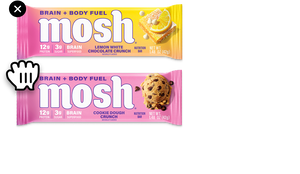

The Science Behind MOSH
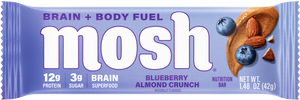
Short answer: MOSH bars are formulated with a Signature Brain Blend of 6+ brain and body ingredients, led by 125mg of Cognizin® Citicoline per bar. At 250mg (two bars), Cognizin supports focus and attention. Every ingredient is chosen for its research base, and MOSH does not claim to diagnose, treat, cure, or prevent any disease.
These statements have not been evaluated by the Food and Drug Administration. This product is not intended to diagnose, treat, cure, or prevent any disease.
What is Cognizin® Citicoline?
Citicoline (CDP-choline) is a naturally occurring compound. As a form of choline, it supports phospholipid metabolism and acetylcholine production, supports brain cell signaling, and supports dopamine and norepinephrine production. Cognizin® is a branded, clinically studied form of citicoline. MOSH includes 125mg of Cognizin® per bar, so a two-bar serving delivers 250mg.
These statements have not been evaluated by the Food and Drug Administration. This product is not intended to diagnose, treat, cure, or prevent any disease.
What the research on citicoline shows
MOSH points to published, peer-reviewed research on its ingredients rather than to claims about the finished bar. On citicoline specifically:
- In a randomized, placebo-controlled trial, 28 days of Cognizin® citicoline was studied for attention and psychomotor speed, with the citicoline group outperforming placebo (McGlade et al., Journal of Attention Disorders, 2015). DOI: 10.1177/1087054715593633
- In a separate randomized, double-blind, placebo-controlled trial, 500mg/day of Cognizin® citicoline was studied for cognitive function in healthy older adults (Nakazaki et al., The Journal of Nutrition, 2021). DOI: 10.1093/jn/nxab119
These are studies of the ingredient citicoline, cited here for transparency about the research base. MOSH's own claim is limited to what its dosing supports: at 250mg across two bars, Cognizin supports focus and attention.
These statements have not been evaluated by the Food and Drug Administration. This product is not intended to diagnose, treat, cure, or prevent any disease.
What the Research Does and Does Not Show
Being clear about what the research base does and does not establish matters as much as citing it. Here is what the named studies behind Cognizin® actually studied:
- McGlade et al., 2012 (Food and Nutrition Sciences): 60 healthy women aged 40 to 60 took 250mg or 500mg of Cognizin® per day for 28 days; the 250mg group showed improved attention on a standard test.
- McGlade et al., 2015 (Journal of Attention Disorders): a study of adolescent males took Cognizin® for 28 days and showed improved attention and psychomotor speed versus placebo.
- Silveri et al., 2008 (NMR in Biomedicine): 16 healthy men and women took 500mg or 2000mg of Cognizin® per day for 6 weeks; brain-scan measures of energy-related compounds increased, most in the group that took the lower dose.
- Babb et al., 2002 (Psychopharmacology): a small group of healthy older adults took 500mg of Cognizin® per day for 6 weeks; brain-scan measures linked to cell-membrane building blocks increased.
Taken together, the evidence is strongest for focus and attention at a 250mg dose (two MOSH bars) in healthy adults, which is the one claim MOSH makes. It is not evidence that Cognizin® supports memory: regulators have reviewed a memory claim for citicoline and did not approve it (the European Food Safety Authority's 2024 opinion found the evidence insufficient to support a memory-function health claim), which is why MOSH does not make one.
Two honest caveats about this research base: several of the key trials, including some cited above, were funded by Kyowa Hakko Bio, the company that manufactures Cognizin® and supplies it to MOSH, and most of these studies involved small groups of participants, as few as 16 to 60 people. That does not make the findings wrong, but it means they should be read as promising early evidence, not settled science.
These statements have not been evaluated by the Food and Drug Administration. This product is not intended to diagnose, treat, cure, or prevent any disease.
The rest of the Brain Blend
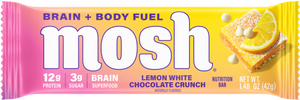
Alongside Cognizin® Citicoline, every MOSH bar is formulated with Organic Lion's Mane, KSM-66® Ashwagandha (an adaptogen with a long traditional use), omega-3 fatty acids (from flaxseed), vitamin B12, and vitamin D3, plus 11-20g of protein depending on the line and 4g of sugar or less. Lion's Mane is a functional mushroom that has been studied for its potential effects on nerve growth factor (NGF) support.
These statements have not been evaluated by the Food and Drug Administration. This product is not intended to diagnose, treat, cure, or prevent any disease.
Our Scientific Advisory Board
MOSH's formulation is informed by our Scientific Advisory Board. Meet the board to see the credentials behind the brand.
Frequently asked questions
Is there science behind MOSH?
Yes. MOSH's ingredients are chosen for their published research base. Cognizin® citicoline, the lead ingredient, has been studied in randomized controlled trials for attention and cognitive function. MOSH's own claim is that at 250mg (two bars), Cognizin supports focus and attention. These statements have not been evaluated by the Food and Drug Administration. This product is not intended to diagnose, treat, cure, or prevent any disease.
How much Cognizin is in a MOSH bar?
Each MOSH bar contains 125mg of Cognizin® Citicoline, so a two-bar serving delivers 250mg.
Does MOSH make disease claims?
No. MOSH is a food, not a drug. It is not intended to diagnose, treat, cure, or prevent any disease.
Go deeper
More from MOSH on the ingredients and questions covered here:
- Protein Bars with Cognizin Citicoline (2026 Guide)
- Citicoline in Snack Bars: Does the Dose Matter?
- Is a Protein Bar a Legit Way to Get Citicoline?
- Protein Bars with Citicoline for Brain Health
- Do Brain-Fueling Protein Bars Actually Work?
- Is It the Protein or the Brain Ingredients Doing the Work?
- Omega-3, B12 & Ashwagandha Bars: Do They Boost Brain + Energy?
- Do Protein Bars With 6+ Brain Ingredients Actually Taste Good?
- MOSH in the press